

Missing teeth are not only an aesthetic problem, but also a significant issue in terms of chewing function and oral health. Today, one of the most effective and long-lasting solutions to this problem is dental implant treatment.
What is a Dental Implant?
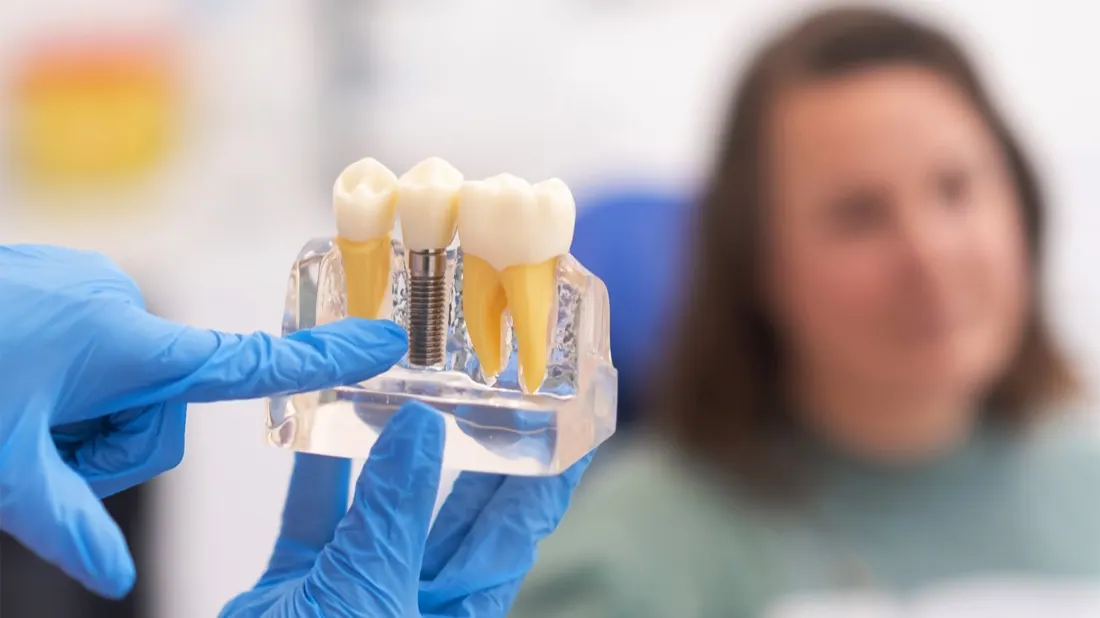
A dental implant is an artificial tooth root placed in the place of a missing tooth. It is usually made of titanium and placed in the jawbone. A dental prosthesis (crown) made of porcelain or zirconium is then attached to the implant.
This structure consists of three parts:
- Implant screw – Embedded into the jawbone (acts as a root)
- Abutment – Connects the implant to the tooth
- Crown (artificial tooth) – The part visible in the mouth
The goal is to mimic the natural tooth structure both aesthetically and functionally.
How Does a Dental Implant Work?
After the implant is placed, it biologically bonds with the jawbone. This process is called osseointegration. The bone surrounds the implant, securing it in place. As a result:
- It does not move during chewing
- It transmits force to the bone like a natural tooth root
- It helps reduce bone loss
This results in a fixed, sturdy, and natural-looking tooth.
Who is Eligible for Implants?
Dental implant treatment is generally suitable for:
- Those missing one or more teeth
- Those who do not want to use dentures
- Patients who do not want to cut their healthy teeth for a bridge
- Individuals whose general health is suitable for surgery
Individuals whose jawbone development is complete (usually over 18 years of age)
Smoking, diabetes, or certain systemic diseases may affect the treatment plan; therefore, a detailed evaluation is required.
What Should Those with Bone Deficiency Do?
Many patients wonder, “If there is no bone, can implants be placed?” Today, this situation can often be resolved.
Methods used:
Bone Graft (Bone Powder Application)
Bone support is provided to the area with low bone volume.
Sinus Lift
Applied in cases of bone insufficiency in the back of the upper jaw.
Block Graft
Can be performed to increase bone volume in cases of more advanced bone loss.
Custom-Designed Implants
In some cases, shorter or angled implants may be preferred.
Once bone support is provided, the implant can be safely placed.
Dieser Beitrag dient der allgemeinen Information und ist keine Diagnose oder Behandlungsempfehlung. Bitte sprechen Sie mit einer Ärztin oder einem Arzt. Dieser Beitrag wird im englischen Originaltext veröffentlicht.